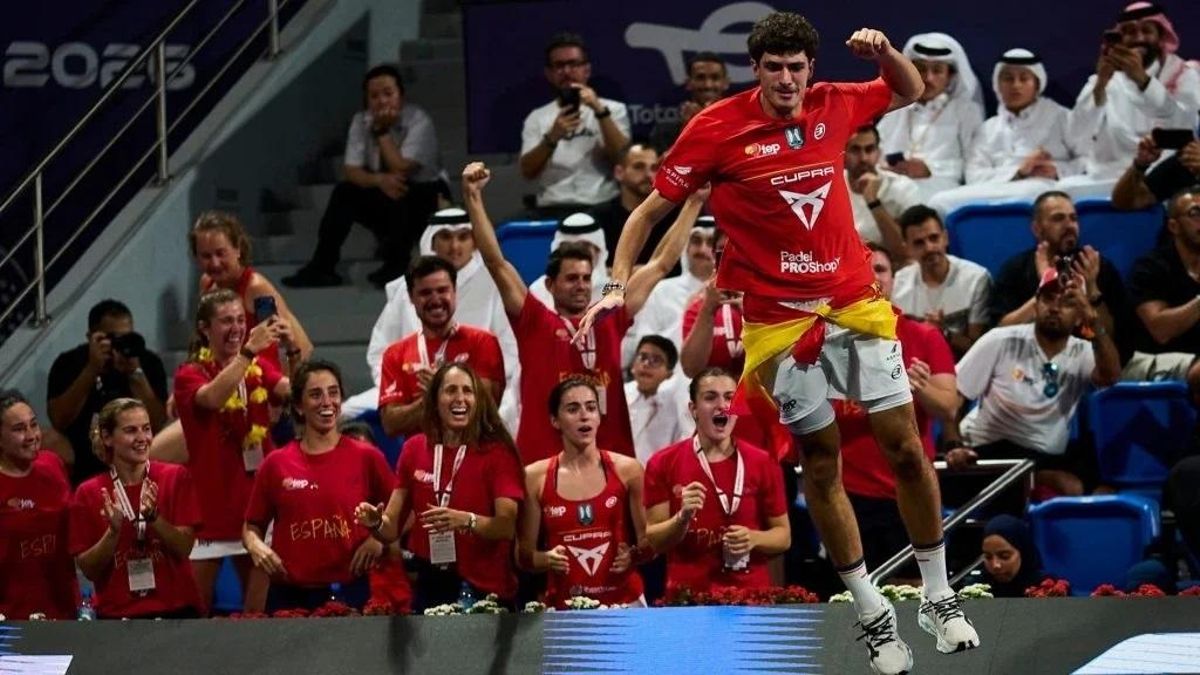
Spain’s FIP World Cup double: why saving Coello for last paid off
By Courtsider · November 8, 2026
Spain beat Argentina 2-1 to reclaim the men’s FIP World Cup, but Arturo Coello nearly spent the final on the bench. When Juan Lebrón and Aimar Goñi trailed Martín Di Nenno and Leo Augsburger by a set and a break, Arturo Coello was still waiting for the third match. Argentina had Agustín Tapia and Federico Chingotto up next. Had the opening lead held and Argentina won the second match as it did, there would have been no third.
Instead, Lebrón and Goñi won the opener, Tapia and Chingotto levelled the tie, and Coello and Coki Nieto closed out the victory at the Khalifa International Tennis and Squash Complex in Doha on 7 November. Spain’s women beat Argentina 2-0 to complete the double and win their seventh consecutive team title. For the men, who had lost the two previous finals to Argentina, coach Juanjo Gutiérrez’s distribution of players across the three matches shaped how Spain won.
What Spain risked by putting Coello third
The team format rewards two match wins, so winning one court by a large margin does nothing for the other two. Putting Coello in the opening match would have guaranteed he played. Putting him third kept Spain’s most imposing attacking player available for a decider, at the risk that the tie would already be over. That trade-off mattered more than any assessment of which country could put the strongest single pair on court.
Gutiérrez was already without Ale Galán, who withdrew injured before the tournament and was replaced in the squad by Javi Leal. Goñi had partnered Mike Yanguas against Portugal in the semifinal; for the final, Gutiérrez paired the World Cup debutant with Lebrón and put them on first. He chose Paquito Navarro and Jon Sanz for the second slot, leaving Coello and Nieto for the third.
Afterward, Gutiérrez explained that he wanted Coello in the last match because he trusted his composure in a deciding situation. Coello acknowledged that he had not been fully convinced by the order. Pairing him with Nieto gave that choice a sound basis: they had supplied Spain’s only point in the 2024 final, when they played first. Gutiérrez moved a proven pairing to a different place in the tie.
The opener that kept the plan alive
Di Nenno and Augsburger justified Argentina’s faith in them for much of the first two sets. At 5-5 in the opening set, Augsburger punished two Goñi smashes with counters. Argentina took the set 7-5 and broke ahead 4-2 in the second. In a tie with Tapia and Chingotto still to come, that was an excellent position for Argentina and a dangerous one for Spain.
Goñi changed the terms of the overhead exchange. At 5-5 in the second, he countered an Augsburger smash to help Spain break. Di Nenno and Augsburger still earned two break points in the next game, but Lebrón and Goñi held for 7-5. Spain broke early in the third and closed it 6-2. Lebrón’s experience helped keep the pair in the match; Goñi supplied a direct answer to the shot that had hurt them in the first set. That recovery is why the selection deserves credit beyond the novelty of putting a debutant on first.
Tapia and Chingotto then won 6-1, 6-2 in 55 minutes. Navarro and Sanz’s defeat was decisive on their court, but it cost Spain one point, just as a much closer loss would have. Argentina’s strongest pairing did everything its coaches needed from it in the second slot. The comeback in the first match meant that commanding performance levelled the final instead of ending it.
Why playing away from Coello was only half an answer
At 1-1, Tino Libaak and Gonzalo Alfonso faced the pairing Spain had held back. The FIP match report noted that Argentina tried to limit Coello’s involvement. There is an obvious attraction to that approach: fewer balls in his hitting zone should mean fewer chances for him to end points. But it also asks the other Spaniard to handle more of the play. Nieto was good enough on the night to make that choice expensive. Argentina broke first, yet Spain won 6-3, 6-2.
That is the strongest argument for Gutiérrez’s choice of partner as well as his choice of order. Spain had a threat in Coello that Argentina wanted to avoid, and a player in Nieto who could make avoiding him an insufficient plan. Coello was the headline name in the decider, but the pairing worked because Argentina could not solve the problem simply by redirecting the ball.
What Argentina could reasonably have changed
Gabriel Reca and Rodrigo Ovide fielded two pairs with persuasive cases. Di Nenno and Augsburger had opened the semifinal against Italy with a 6-1, 6-1 win, and they got within sight of a straight-sets victory in the final. Tapia and Chingotto gave Argentina a clear route to one point. Libaak and Alfonso already played together on tour, so the deciding slot went to a pair with shared experience rather than a combination assembled solely for the occasion.
Leaving Franco Stupaczuk out is the decision most worth revisiting. Reuniting him with Di Nenno could have freed Augsburger to play with Libaak, the pair that won the deciding match in Doha in 2024. But that alternative changes two matches at once. It removes a semifinal-tested opening pair, and it does not guarantee a better third-match result against Coello and Nieto. In 2024, Coello and Nieto had already beaten Stupaczuk and Di Nenno, while Libaak and Augsburger won the title against a different Spanish pair. The previous final gives both arguments evidence, without settling either.
Argentina’s selections gave it a credible route to winning the first two matches, and for a set and a break that route was open. The fair criticism is that its third pair had no convincing answer once the final reached the slot Spain had strengthened. The result does not show that an alternative would have won. It shows how much the value of the deciding pair depended on what happened before either player walked on court.
Spain’s women win with a different balance
Carolina Navarro used a current partnership to start and a pairing she had already used in the semifinal to finish. Ari Sánchez and Andrea Ustero beat Martina Fassio and Aranzazu Osoro 6-3, 6-3. At 0-40 in the last game, the Spanish pair saved three break points and closed it out on the Star Point. Ustero, like Goñi, was making her World Cup debut; beside her was a player she knew from the tour.
Gemma Triay and Paula Josemaría then beat Delfi Brea and Claudia Jensen 6-2, 6-7, 6-3 in two hours and 38 minutes. Brea, Triay’s regular tour partner, was on the opposite side of the net. Argentina took the second-set tiebreak and stayed in the match deep into the third, before Spain broke for 5-3 and served out the title. The overall 2-0 was clean; the second point was anything but straightforward.
Spain’s two titles came from different uses of depth. Navarro gave a debutant a familiar partnership and asked a proven semifinal pair to close. Gutiérrez changed Goñi’s partner, accepted the risk of a difficult middle match, and kept Coello and Nieto in reserve. His most important decision was not simply to put Coello last. It was to trust an opening pair capable of making the last match matter.