World Cup 2026 guide: Argentina’s defence, Spain’s challenge and how Doha works
By Courtsider · November 1, 2026
Argentina’s men return to Doha defending a World Cup crown that Spain have not held since 2021. For six days at the FIP World Cup 2026, the decisive unit is a national squad, with captains assembling doubles line-ups to win ties. Familiar partnerships give way to country allegiance: Arturo Coello represents Spain and Agustin Tapia Argentina. Spain’s women arrive as defending champions.
The competition runs from 2–7 November at the Khalifa International Tennis and Squash Complex in Doha, Qatar. There are 16 men’s national teams and 16 women’s national teams, with separate titles. The group draw was held on 1 November and is now confirmed. The announced prize fund is €1.2 million, divided equally between the two competitions.
What makes this World Cup different?
This is a championship for countries. A national squad supplies the players for a series of doubles matches against another nation; the points earned by those pairs decide the team tie.
That changes the significance of familiar names. Professional partners from different countries can become opponents, while compatriots who normally compete against one another can share a court. Captains must decide how to distribute their players across the line-up. A strong first pair does not, by itself, secure the team result.
It is also separate from the World Cup Pairs competition. The 2025 pairs titles in Kuwait went to Alejandro Galan/Federico Chingotto and Ariana Sanchez/Paula Josemaria. Those are not the national-team trophies being defended in Doha.
The format: groups, Quarter-finals and a full placement competition
Each draw begins with four groups of four countries. Every nation faces the other three in its group, and the leading two from each group advance to the Quarter-finals. Third and fourth place send a team into the competition for positions ninth to 16th, so missing the title bracket does not end its week.
The senior squad regulations allow between six and eight registered players per national team. A tie is organised around three doubles matches, commonly called rubbers. Each rubber contributes one point to the team score: winning two secures the tie. A 2-1 national-team result therefore describes rubber wins, not sets. Within each rubber, the pairs play their own match and set scores.
The technical rules prohibit a player from appearing in more than one rubber in the same tie. Captains can change their pairings between ties, making selection and rotation part of the competition rather than a fixed eight-player draw.
FIP’s qualification regulations give automatic places to the previous edition’s Semi-finalists and to the host, with the host place reallocated if already covered. The remaining field comes through the continental qualification structure. The group lists below are the confirmed final field, rather than a list of every country that entered qualifying.
The schedule
- 2–4 November: group-stage play.
- 5 November: Quarter-finals and the placement phase.
- 6 November: Semi-finals.
- 7 November: third-place play-offs and Finals.
The announced group-stage sessions start at 14:00 Doha time for the women and 18:00 for the men. For readers in Cyprus, those times are 13:00 and 17:00. The opening-day order of play lists the men’s session as not before 18:00, so it should not be read as a guaranteed start for every rubber. Individual court assignments and times remain subject to the official daily programme.
Confirmed men’s groups
- Group A: Argentina, France, Australia, Netherlands.
- Group B: Spain, United Arab Emirates, Sweden, Paraguay.
- Group C: Portugal, Chile, Qatar, Germany.
- Group D: Italy, Brazil, United States, Mexico.
Argentina’s defence begins in Group A, with France among its opponents. Spain’s route starts in Group B. The draw also gives Portugal, bronze medallists in 2024, a group containing the hosts, while Italy and Brazil meet in Group D. These are the starting groups, not predictions of the knockout line-up.
The men’s squads at the centre of the title race
Argentina: Agustin Tapia, Federico Chingotto, Leandro Augsburger, Franco Stupaczuk, Martin Di Nenno, Maximiliano Arce, Valentino Libaak and Gonzalo Alfonso.
That selection offers Argentina several established combinations and the option to build different pairs. Tapia and Chingotto are joined by Stupaczuk and Di Nenno, while Augsburger and Libaak were part of the successful 2024 team. Gaby Reca is a central figure on Argentina’s coaching bench, with Rodrigo Ovide also part of the national-team staff.
Spain: Arturo Coello, Paquito Navarro, Juan Lebron, Mike Yanguas, Jon Sanz, Coki Nieto, Aimar Goñi and Javi Leal.
The important late change is Leal’s inclusion for Alejandro Galan, who withdrew for medical reasons. Juanjo Gutierrez therefore has to construct Spain’s challenge without Galan. It would be premature to present possible pairings as confirmed selections: the squad list establishes who is available, not which pair will play each rubber.
Beyond the two recent men’s champions, Portugal can call on Nuno and Miguel Deus, Peu Araujo and Pedro Graça. Italy’s options include Flavio Abbate and Alvaro Montiel. France’s younger players include Jeremy Robert, Yoan Boronad and Timeo Fonteny, while Lucas Bergamini is among Brazil’s leading names. The group phase will establish which squads can turn those options into the results needed for the last eight.
The women’s competition
Spain defend the title with Andrea Ustero, Ariana Sanchez, Beatriz Gonzalez, Claudia Fernandez, Gemma Triay, Marta Ortega, Martina Calvo and Paula Josemaria. Carolina Navarro leads the team. Argentina’s selection is Delfina Brea, Claudia Jensen, Aranzazu Osoro, Martina Fassio, Maria Laura Ferreyra, Virginia Riera, Julieta Bidahorria and Victoria Vilches.
The confirmed groups are:
- Group A: Spain, Brazil, Germany, Great Britain.
- Group B: Argentina, France, Chile, Belgium.
- Group C: Italy, Sweden, Egypt, Indonesia.
- Group D: Portugal, Netherlands, United States, Paraguay.
Spain’s 2024 victory was its sixth successive women’s national-team title. Argentina were runners-up, with Italy third. Those results provide context for the defending champions’ task; they do not settle what happens in this edition.
Scoring and rules to understand before watching
There are three layers to follow: points and games within a set, sets within a rubber, and rubbers within the national-team tie. Winning a long individual match is still worth one rubber, just as a more straightforward win is.
FIP’s general World Championship technical rules specify best-of-three-set matches and a tie-break at 6-6, unless the needs of the competition establish a different format. Event-specific instructions remain decisive. A Premier Padel scoring announcement should not automatically be treated as a World Cup rule.
Group standings are a separate calculation from a rubber’s score. The published team technical rules use direct encounters to separate two tied teams. For a three-team tie, they compare rubber difference, then set difference and then game difference within the tied teams’ encounters. Doha’s event-specific instructions and the competition officials remain authoritative; a spectacular scoreline in one rubber is not, on its own, proof that a country has qualified.
Selection also has limits: national federations register the players, who must meet FIP’s country-representation eligibility rules and hold the required federative licence. This is not an open invitation to choose a tour partner of any nationality.
Winners from the last five editions
The most recent five national-team editions were 2016, 2018, 2021, 2022 and 2024. Their records are:
- 2016 — Cascais, Portugal: Argentina won the men’s title; Spain won the women’s title.
- 2018 — Asuncion, Paraguay: the men’s final was not played; Spain won the women’s title.
- 2021 — Doha, Qatar: Spain won both titles.
- 2022 — Dubai, United Arab Emirates: Argentina won the men’s title; Spain won the women’s title.
- 2024 — Doha, Qatar: Argentina won the men’s title; Spain won the women’s title.
The 2018 distinction matters: the official national-team roll of honour lists the men’s final as not played, so no winner is assigned here. It should not be confused with that edition’s separate national-pairs results.
What to follow through the week
Start with the captain’s three pairs, then the rubber scores and the group table. Watch whether a team rotates players in the groups, which combinations it trusts as the stakes rise, and how the placement matches develop alongside the title bracket. Confirmed selections and completed results will be more useful than assuming a country will reproduce its players’ usual professional partnerships.
The official FIP event page links the group tables and daily order of play. Those are the reference points for fixtures and results as the week develops. Argentina’s men and Spain’s women begin as holders; the draw gives every team its route, but the results still have to be earned on court.
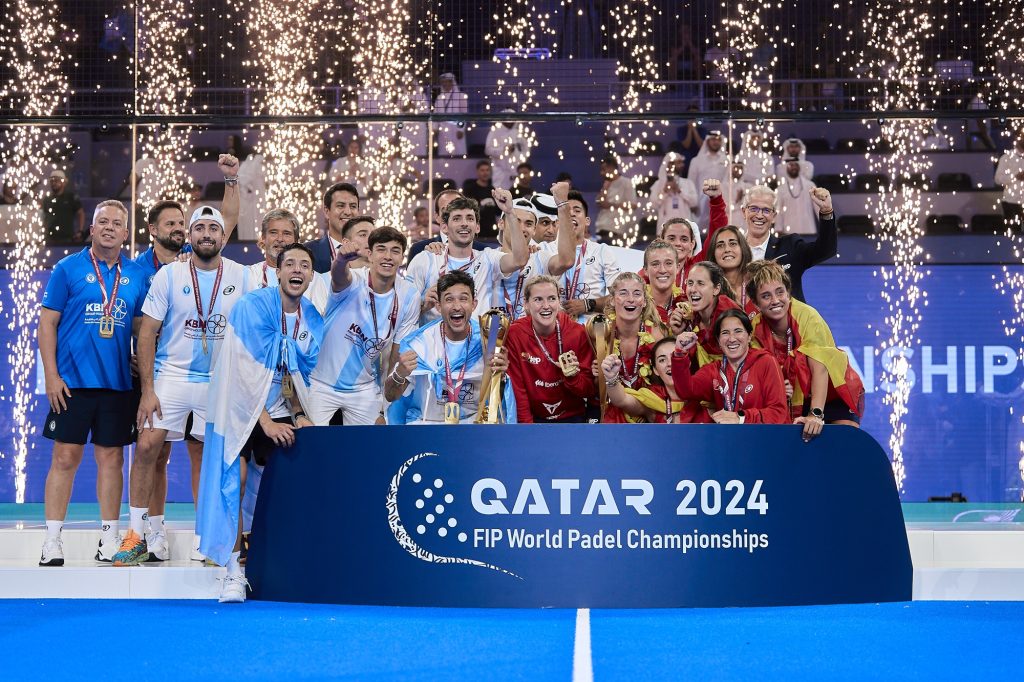
Archive photo: Argentina’s men and Spain’s women at the 2024 World Championships in Qatar. Photo: FIP.